

You Don’t Have a Tool Problem. You Have an Operations Problem.

Updated: May 2
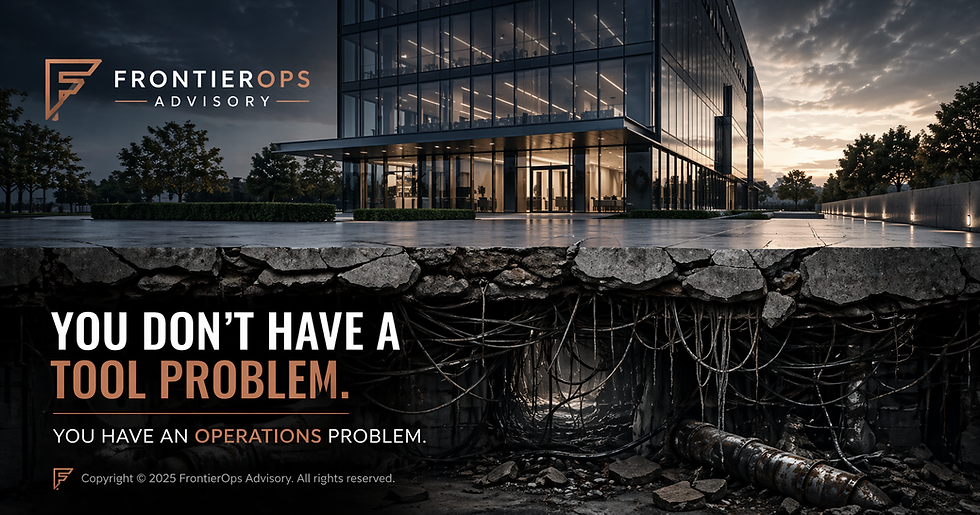
Why unclear ownership, broken service models, and unstable operations — not bad tools — are the real reason systems fail
Most organizations don’t have a technology problem.
They have an operations problem.
And that’s not a critique. It’s a diagnosis.
The Lie Everyone Quietly Believes
Walk into almost any enterprise and you’ll hear some version of this:
“We just need better tools.”
No, you don’t.
You already have:
Jira
ServiceNow
Salesforce
Dashboards stacked on dashboards
Enough SaaS subscriptions to fund a small country
And yet… things still break.
Incidents drag on.Changes fail.Ownership is unclear.Leadership gets reports that look clean—but feel wrong.
That’s not a tooling issue.
That’s structural failure.
Why Systems Actually Fail
Systems don’t fail because the tools are bad.
They fail because the operational reality underneath them is unstable.
Here’s what that looks like:
1. Ownership Is Unclear
Ask a simple question:
“Who owns this service?”
You’ll get answers like:
“It’s kind of shared…”
“Depends on the component…”
“We used to have someone for that…”
That’s not ownership. That’s diffusion.
If everyone owns it, no one owns it.If no one owns it, nothing gets fixed properly.
2. Services Don’t Map to Reality
On paper, the service catalog looks perfect.
Clean structure. Logical grouping. Executive-ready.
Then production hits.
And suddenly:
One “service” is actually 12 systems duct-taped together
Another hasn’t existed in years
Critical dependencies aren’t modeled anywhere
It’s a map that shows roads… but not cliffs.
Looks good. Gets people hurt.
3. Data Is Duplicated or Conflicting
Same system. Same concept. Multiple answers.
CMDB says one thing
Monitoring says another
A spreadsheet someone built three years ago says something else
Now your teams aren’t solving problems.
They’re debating reality.
And nothing burns time faster than arguing over which version of the truth is correct.
4. Workflows Look Complete… Until They’re Tested
On a whiteboard, everything works.
Incident flows are clean. Change processes are defined.Request models are documented.
Then something real happens.
A Sev-1 hits at 2:17 AM.
And suddenly:
Steps are skipped
Ownership is unclear
Escalations stall
People improvise
The workflow didn’t fail.
It was never real to begin with.
The Natural (and Wrong) Response
When systems start breaking, teams don’t step back.
They compensate.
They add:
More dashboards
More process
More tools
It feels productive.
It looks like progress.
But it’s not.
It’s repainting the walls on a crooked foundation.
A Pattern We’ve Seen for 20+ Years
We’ve walked into environments where:
14 dashboards exist for the same operational domain
5 teams believe they own the same system
Incidents require multiple channels just to determine who’s in charge
Smart people. Good intentions.
Broken structure.
And no tool in the world was going to fix that.
The Core Truth
If operations aren’t stable…
Everything else is a fantasy.
Your:
Digital transformation
AI strategy
Platform modernization
Executive dashboards
All of it.
Fantasy.
Because the moment real pressure hits, the system collapses back to chaos.
The FrontierOps Approach
This is where most people expect a tool recommendation.
There isn’t one.
FrontierOps is not a toolset.
It’s a systems framework built around one principle:
You don’t scale chaos. You stabilize it first.
The order matters.
Step 1: Stabilize the Operation
Identify what actually runs the business.
Strip away noise.
Focus on what breaks under pressure.
This is triage, not theory.
Step 2: Align the System to Reality
Not the diagram.
Not the slide deck.
Reality.
What actually exists.How it actually behaves.Where it actually fails.
You don’t get points for elegance.
You get points for truth.
Step 3: Establish Ownership
Clear. Named. Accountable.
One service → one owner
One escalation path → one accountable team
No ambiguity
This is where most organizations hesitate.
Because ownership creates accountability.
And accountability is uncomfortable.
Step 4: Then—and Only Then—Scale
Now you can:
Add tooling
Optimize workflows
Build dashboards
Introduce automation
Now it works, because it’s built on something real.
The Pit Stop Reality Check
Modern F1 teams execute pit stops in under 2 seconds.
Perfect coordination. Clear roles. Absolute precision.
Now take that same playbook and hand it to:
An untrained team
With unclear ownership
Using outdated tools
And no coordination
You don’t get a slower pit stop.
You get chaos.
That’s what most organizations are doing.
Running advanced systems… on unstable operations.
What We Actually Do
We don’t come in to configure tools.
We don’t add more process.
We don’t build prettier dashboards.
We do the following:
Expose the gap between perception and reality
Rebuild the operational foundation
Create systems that hold under pressure
That’s the only test that matters.
Not how it looks in a demo.
Not how it reads in a document.
But how it performs when everything is on fire and people are tired.
Final Thought
You don’t have a technology problem.
You have an operations problem.
Fix that…
And your tools will finally start working the way you thought they would.
Ignore it…
And you’ll keep buying better hammers for a house that doesn’t have a foundation.
Copyright © 2025 FrontierOps Advisory. All rights reserved.


Comments